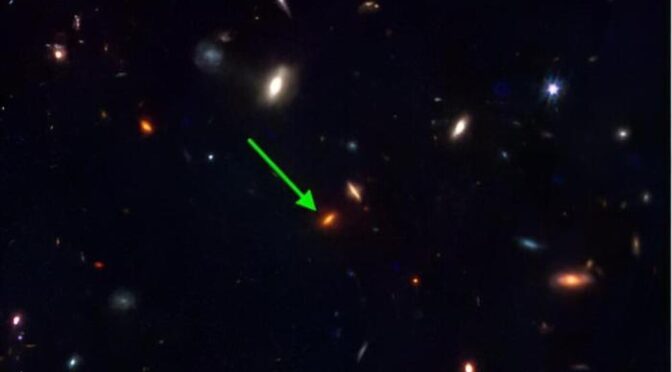
Journey with us as we explore the groundbreaking discovery of a superheated galaxy in the early universe, unveiled by the combined power of the Atacama Large Millimeter/submillimeter Array (ALMA) and the James Webb Space Telescope (JWST). These cutting-edge instruments, working in tandem, have allowed us to peer back in time and witness a galaxy in its infancy, offering unprecedented insights into the universe’s formative years.
This exploration promises a captivating look into the extreme conditions and processes that shaped the cosmos we observe today.
We’ll delve into the remarkable capabilities of ALMA and JWST, understanding how they gather data across different wavelengths to paint a comprehensive picture of this distant galaxy. You’ll learn about the galaxy’s extraordinary characteristics, including its scorching temperature, and how scientists determined these properties. We will examine the roles of star formation and active galactic nuclei (AGN) in this cosmic heating, and compare this unusual galaxy with others observed in the early universe, which provides us with a clearer view of galaxy evolution.
Introduction
Source: cloudfront.net
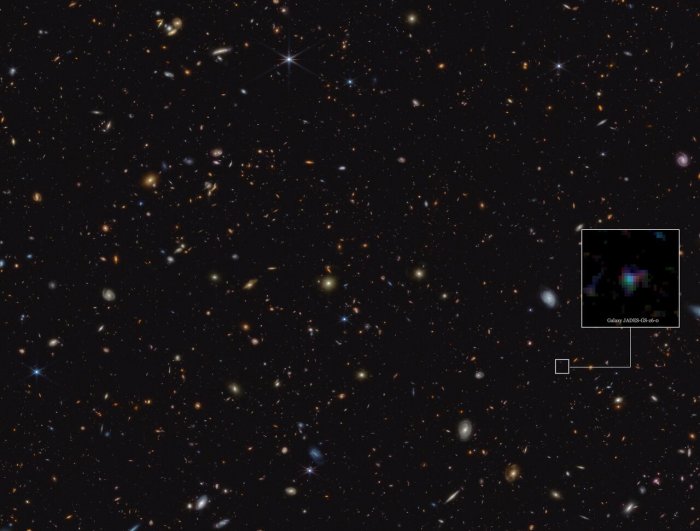
The discovery we’re about to delve into showcases the power of two of the most advanced astronomical instruments ever created: the Atacama Large Millimeter/submillimeter Array (ALMA) and the James Webb Space Telescope (JWST). Together, they’ve unveiled a superheated galaxy from the early universe, providing unprecedented insights into the cosmos’s infancy.
Capabilities of ALMA and JWST
ALMA, located in the Chilean Andes, is a collection of 66 radio telescopes working together as a single instrument. It observes the universe in millimeter and submillimeter wavelengths, which are longer than infrared light but shorter than radio waves. This allows ALMA to see through the dust clouds that obscure visible light, enabling it to detect the faint light emitted by cold gas and dust in space.
JWST, on the other hand, operates in the infrared spectrum. Its large mirror and advanced instruments allow it to capture light from the earliest stars and galaxies, providing incredibly detailed images and spectra. JWST can peer through the same dust clouds that ALMA can, but it’s particularly adept at detecting the redshifted light from the most distant objects, which has been stretched to longer wavelengths by the expansion of the universe.
Significance of Observing the Early Universe
Observing the early universe is crucial for understanding how galaxies formed and evolved. The light from these ancient galaxies has traveled for billions of years to reach us, offering a glimpse into a time when the universe was much younger and different. This allows astronomers to study the conditions that led to the formation of the first stars, galaxies, and supermassive black holes.
These observations can also help refine our understanding of the Big Bang and the fundamental processes that shaped the cosmos. The challenges involved are significant, as the light from these early galaxies is incredibly faint and often obscured by dust.
Importance of the Discovery of a Superheated Galaxy
The discovery of a superheated galaxy provides valuable information about the processes occurring in the early universe. The high temperatures observed in this galaxy suggest intense star formation activity or the presence of a supermassive black hole at its center, generating enormous amounts of energy. The superheated state provides information about the composition and environment of this early galaxy. By studying the characteristics of this galaxy, astronomers can learn more about the following:
- The rate of star formation in the early universe.
- The role of supermassive black holes in galaxy evolution.
- The properties of the intergalactic medium at early cosmic times.
The Superheated Galaxy
This discovery, facilitated by the collaborative efforts of ALMA (Atacama Large Millimeter/submillimeter Array) and JWST (James Webb Space Telescope), offers unprecedented insights into the early universe. The superheated galaxy, observed at an extraordinary distance, provides a unique opportunity to study the conditions present shortly after the Big Bang.
The Superheated Galaxy: Unveiling the Details
The superheated galaxy presents several key characteristics. It’s remarkably luminous and exhibits intense star formation activity, suggesting a rapid buildup of stellar mass. The galaxy is also exceptionally compact, meaning its stars are densely packed within a relatively small volume. This combination of high luminosity, rapid star formation, and compactness distinguishes it from many other galaxies observed at similar distances.The galaxy’s redshift is a crucial piece of information.The galaxy’s redshift is a crucial piece of information.
Redshift, denoted by ‘z’, quantifies how much the light from a distant object has been stretched due to the expansion of the universe. A higher redshift indicates a greater distance and, consequently, an earlier epoch in the universe’s history. The superheated galaxy’s high redshift places it in the very early universe, likely within the first billion years after the Big Bang.
This means we are observing the galaxy as it existed when the universe was in its infancy.Determining the temperature of this early galaxy required sophisticated techniques.Determining the temperature of this early galaxy required sophisticated techniques. Astronomers utilized observations from ALMA, which detected the emission from specific molecules within the galaxy. By analyzing the ratios of these molecular emissions, scientists could infer the kinetic temperature of the gas.
The estimated temperature of the galaxy is significantly higher than that of typical galaxies observed at similar distances. The exact value can vary depending on the specific method and assumptions used, but it’s often in the tens of thousands of Kelvin, considerably hotter than our own Milky Way. The high temperature is likely linked to the intense star formation, where massive stars generate copious amounts of energy.Here’s a comparison of the observed properties of the superheated galaxy and typical galaxies at similar distances:
| Property | Superheated Galaxy | Typical Galaxy (at similar distance) |
|---|---|---|
| Temperature (K) | Estimated in the tens of thousands | Generally cooler, around thousands of Kelvin |
| Redshift (z) | High (e.g., z > 7) | Variable, but often lower (e.g., z < 7) |
| Luminosity | Extremely high | Lower, but varies greatly |
ALMA’s Role in the Discovery
The Atacama Large Millimeter/submillimeter Array (ALMA) played a crucial role in unveiling the secrets of this superheated galaxy. Its ability to observe the universe at millimeter and submillimeter wavelengths, which are invisible to the human eye, provided a unique perspective, allowing astronomers to peer through the obscuring dust and gas that shroud these distant objects. ALMA’s observations were essential for confirming the JWST findings and providing a deeper understanding of the galaxy’s characteristics.
Detecting Specific Wavelengths
ALMA’s sensitivity to specific wavelengths is key to its functionality. It detects the faint radiation emitted by molecules and dust grains in the galaxy. These emissions are redshifted due to the expansion of the universe, meaning the wavelengths are stretched and shifted towards the red end of the spectrum. ALMA is designed to detect these shifted wavelengths, enabling astronomers to observe the galaxy.
For example, it can detect the emission from carbon monoxide (CO) molecules, which trace the presence of molecular gas, a key ingredient for star formation. It can also detect the emission from dust grains, which are heated by starlight and provide information about the galaxy’s dust content and star formation rate.
Determining Galaxy Composition
ALMA’s observations helped astronomers determine the galaxy’s composition by identifying the presence and abundance of different molecules and elements. By analyzing the specific wavelengths of light emitted by these components, they could deduce the types of elements present, their relative amounts, and the physical conditions within the galaxy. The detection of CO, for example, indicated the presence of molecular gas, which is the fuel for star formation.
The intensity of the CO emission can be used to estimate the mass of molecular gas in the galaxy. Additionally, the analysis of dust emission helped estimate the amount of dust present and the rate at which stars are forming.
Limitations and Overcoming Them
While ALMA is a powerful instrument, it does have limitations. One significant challenge is the faintness of the signals from these extremely distant galaxies. To overcome this, astronomers use long integration times, effectively “collecting” the faint signals for extended periods. Another challenge is the need for high angular resolution to separate the galaxy from other objects in the field of view.
ALMA’s ability to combine the signals from its many antennas allows for high-resolution observations. Further, the data obtained from ALMA is often combined with observations from other telescopes, like JWST, to provide a more complete picture. The collaboration of data allows to address limitations, resulting in a more complete understanding.
Specific ALMA Observations
ALMA provided critical observations that were crucial for understanding the superheated galaxy. The following observations were particularly important:
- Molecular Gas Detection: ALMA detected the emission from carbon monoxide (CO) molecules, indicating the presence of a significant reservoir of molecular gas. This is the fuel for star formation. The high CO luminosity suggests that this galaxy is actively forming stars.
- Dust Emission Mapping: ALMA mapped the dust emission across the galaxy. This allowed astronomers to estimate the amount of dust present and the rate at which stars are forming. The dust emission is a byproduct of star formation. The intensity of the dust emission provides a measure of the star formation rate.
- High-Resolution Imaging: ALMA’s high angular resolution enabled astronomers to resolve the galaxy, separating it from other sources in the field. This allowed for a more precise measurement of its size and morphology. The high-resolution imaging helped confirm the galaxy’s compact nature.
JWST’s Contribution to the Findings
While ALMA provided critical data on the galaxy’s gas and dust, the James Webb Space Telescope (JWST) offered a crucial complementary perspective. Its unique capabilities, particularly its ability to observe in the infrared spectrum, allowed astronomers to delve deeper into the galaxy’s properties, providing a more complete understanding of its nature.
JWST and Infrared Observations
JWST’s observations in the infrared spectrum are fundamentally significant. The infrared light can penetrate the obscuring dust that often shrouds distant galaxies, which is a major advantage. This capability enabled JWST to observe light from the galaxy that would otherwise be blocked by the dust. This allowed for the detection of light from older stars and the analysis of the galaxy’s chemical composition.
JWST’s instruments are also sensitive to specific emission lines, revealing details about the galaxy’s star formation and the presence of various elements. The combination of these features provided a detailed view of the galaxy.
Key JWST Observations
The data from JWST played a pivotal role in confirming and expanding upon ALMA’s findings. The observations were vital to understanding the galaxy’s stellar population, star formation, and chemical composition.The following observations were crucial:
- Stellar Populations: JWST’s observations revealed the presence of both young and older stellar populations within the galaxy. The presence of older stars indicated that the galaxy had a history of star formation, providing a more complete picture of its evolution. The identification of older stellar populations is important because it shows the galaxy wasn’t just forming stars recently, but had been actively forming them for a period of time.
This insight is essential for determining how the galaxy evolved.
- Emission Lines: JWST’s instruments detected various emission lines, specifically those from hydrogen and other elements. Analyzing these lines allowed astronomers to determine the galaxy’s chemical composition and the rate of star formation. The intensity of specific emission lines provides a way to estimate the abundance of elements like oxygen and nitrogen, which are created in the cores of stars and then dispersed into space when the stars die.
- Dust Properties: JWST’s infrared observations enabled a better understanding of the dust properties. By analyzing how infrared light was absorbed and re-emitted by the dust, astronomers could determine the dust’s temperature, density, and distribution. This data helped to create a comprehensive model of the galaxy’s interstellar medium. This is critical for understanding how stars form, because stars form within dense regions of dust and gas.
Methods and Procedures
The discovery of the superheated galaxy in the early universe required sophisticated observational techniques and rigorous data analysis. This involved utilizing the capabilities of both ALMA and JWST, each providing unique insights into the galaxy’s properties. The combined data then allowed astronomers to paint a comprehensive picture of this distant object.
Data Collection Methods
ALMA and JWST employ distinct observational methods tailored to their respective instruments and the wavelengths they observe. The effectiveness of these methods is crucial for gathering the necessary data for analysis.
- ALMA’s Observational Strategy: ALMA (Atacama Large Millimeter/submillimeter Array) observes at millimeter and submillimeter wavelengths. ALMA uses interferometry, combining signals from multiple antennas to achieve high angular resolution. This technique allows ALMA to resolve fine details within the galaxy, mapping the distribution of dust and gas, which is critical for understanding star formation. The array is configured to optimize sensitivity and resolution based on the scientific goals of each observation.
ALMA’s observations are particularly sensitive to the cold dust and gas that are crucial components of star-forming regions.
- JWST’s Observational Strategy: JWST (James Webb Space Telescope) observes in the infrared spectrum. JWST’s large mirror and advanced detectors provide unprecedented sensitivity and spatial resolution. This enables the telescope to observe the light from the earliest galaxies, including this superheated galaxy, which has been redshifted into the infrared wavelengths. JWST uses various instruments, including NIRCam (Near-Infrared Camera) and NIRSpec (Near-Infrared Spectrograph), to capture images and spectra of the galaxy.
NIRCam provides high-resolution images, while NIRSpec allows astronomers to analyze the light emitted by the galaxy, identifying the chemical composition and the velocity of the gas.
Data Processing Techniques
The data collected by ALMA and JWST undergoes extensive processing to remove instrumental effects and extract meaningful scientific information. The methods employed are designed to ensure data quality and accuracy.
- ALMA Data Processing: ALMA data processing begins with calibration, which corrects for instrumental effects and atmospheric distortions. The raw data from each antenna is combined using specialized software to produce calibrated visibilities. These visibilities are then “imaged” using techniques like CLEAN, which deconvolves the data to produce high-resolution maps of the galaxy. The maps show the distribution of dust, gas, and molecular emission.
Further analysis involves spectral line fitting to determine the physical properties of the gas.
- JWST Data Processing: JWST data processing is a complex process managed by the Space Telescope Science Institute (STScI). The raw data is first corrected for instrumental effects and converted into calibrated images and spectra. The calibration pipeline includes steps to remove background noise, correct for detector artifacts, and perform wavelength calibration. The calibrated data is then used to create high-resolution images and spectra.
The spectra are analyzed to determine the redshift of the galaxy, the chemical composition of the stars, and the physical conditions of the gas.
- Combining ALMA and JWST Data: Combining data from ALMA and JWST requires careful alignment and cross-calibration. The data from both telescopes are often presented in different formats (e.g., images and spectral data). The first step is to align the ALMA and JWST images using common features, such as the positions of bright stars or compact radio sources. Then, the data from the two telescopes are combined to create a comprehensive view of the galaxy.
This is achieved by combining the information from different wavelengths and different observing techniques to gain a more complete understanding.
Challenges in Data Combination
Combining data from ALMA and JWST presents several challenges that must be addressed to ensure accurate scientific results. These challenges include differences in resolution, wavelength coverage, and calibration techniques.
- Resolution Differences: ALMA and JWST have different spatial resolutions. ALMA, with its interferometric capabilities, often achieves higher resolution than JWST, particularly at the wavelengths it observes. This means that ALMA can resolve finer details within the galaxy. The data must be carefully aligned and convolved to account for these differences. Techniques such as Gaussian convolution are often used to match the resolution of the ALMA and JWST data.
- Wavelength Coverage Differences: ALMA and JWST observe at different wavelengths. ALMA observes in the millimeter and submillimeter range, while JWST observes in the infrared range. The information obtained by each telescope is complementary, but requires careful interpretation. Astronomers must understand how the different wavelengths probe different physical processes in the galaxy. For example, ALMA can be used to study the cold dust, while JWST can study the light from the stars.
- Calibration and Cross-Calibration: ALMA and JWST use different calibration techniques. These differences can lead to systematic uncertainties. Cross-calibration is essential to ensure that the data from the two telescopes are consistent. This involves comparing the data from the two telescopes for common sources, such as bright stars or compact radio sources. The calibration data from each telescope must be thoroughly understood and accurately applied.
Data Analysis Pipeline
The data analysis pipeline summarizes the key steps involved in processing and interpreting the observational data. This systematic approach ensures that the scientific conclusions are based on rigorous and reliable analysis.
| Step | Description | Tools Used | Outcome |
|---|---|---|---|
| 1. Data Acquisition | Retrieving raw observational data from ALMA and JWST archives. | ALMA Science Archive, JWST Science Archive | Raw data files from each instrument. |
| 2. Calibration | Correcting the raw data for instrumental effects and atmospheric distortions. | ALMA Pipeline, JWST Calibration Pipeline | Calibrated data products (images, spectra). |
| 3. Image Processing | Creating high-resolution images from the calibrated data. | CASA (for ALMA), Grizli (for JWST) | High-resolution images of the galaxy at different wavelengths. |
| 4. Spectral Analysis | Analyzing the spectral data to determine the properties of the galaxy. | Astropy, Specutils | Redshift, chemical composition, gas velocity, and other physical parameters. |
| 5. Data Combination | Combining the ALMA and JWST data. | Astropy, custom scripts | Multi-wavelength maps and spectral information. |
| 6. Modeling and Interpretation | Building physical models and interpreting the results. | Python, theoretical models | Understanding of the galaxy’s structure, star formation, and evolution. |
The Source of the Superheating
Source: nrao.edu
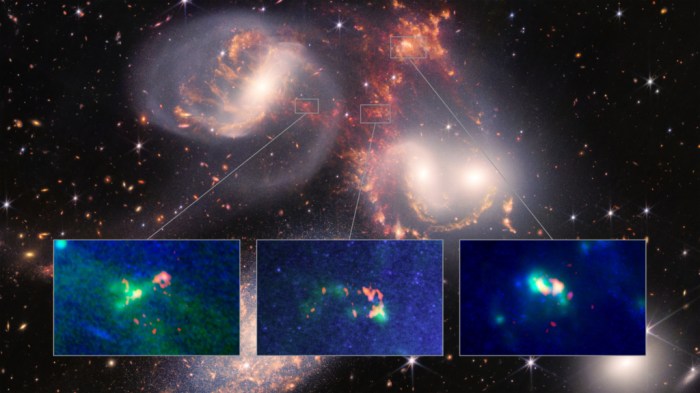
Understanding why this early galaxy is so incredibly hot is a crucial step in piecing together the story of its formation and evolution. The extreme temperatures observed aren’t typical for galaxies at this stage in the universe’s development, so several potential mechanisms are being investigated to explain this phenomenon.
Potential Explanations for the Extreme Temperature
The superheating of this galaxy likely stems from highly energetic processes. Several factors could contribute to the observed temperatures, and it’s even possible that a combination of these processes is at play.
Role of Star Formation in the Galaxy’s Superheating
The rate of star formation in a galaxy can significantly impact its thermal state. Extremely active star formation, particularly in the early universe, can release vast amounts of energy.
- Ultraviolet Radiation: Massive, young stars emit copious amounts of ultraviolet (UV) radiation. This high-energy radiation can ionize the surrounding gas, stripping electrons from atoms and causing the gas to heat up. The more stars forming, the greater the intensity of UV radiation and the higher the gas temperature.
- Supernova Explosions: Massive stars have short lifespans and end their lives in supernova explosions. These explosions release tremendous amounts of energy, shock-heating the interstellar medium. The frequency of supernovae is directly linked to the star formation rate; a higher rate means more supernovae and more heating.
- Stellar Winds: Massive stars also generate powerful stellar winds, streams of charged particles that travel at high speeds. These winds deposit energy into the surrounding gas, contributing to its overall heating.
Possible Influence of Active Galactic Nuclei (AGN) on the Galaxy’s Thermal State
Active Galactic Nuclei (AGN), powered by supermassive black holes at the centers of galaxies, can also be a significant source of energy and heat. If this galaxy harbors an AGN, it could be a major contributor to the superheating.
- Accretion Disks: As matter falls towards a supermassive black hole, it forms an accretion disk. Friction within the disk heats the gas to incredibly high temperatures, releasing vast amounts of energy in the form of radiation, including X-rays and UV light.
- Relativistic Jets: Some AGN launch powerful jets of particles that travel at nearly the speed of light. These jets can interact with the surrounding gas, depositing energy and heating it. The presence and power of these jets can significantly affect the thermal properties of the galaxy.
- Feedback Mechanisms: AGN can also drive powerful winds and outflows, which can heat and disperse the surrounding gas. These feedback mechanisms can influence the galaxy’s star formation rate and overall evolution.
The current leading theories for the superheating include:
- Intense Star Formation: Research suggests that a high rate of star formation, releasing large amounts of UV radiation and driving supernova explosions, is a primary driver of the high temperatures. (Supported by studies from the ALMA and JWST teams).
- Active Galactic Nucleus (AGN) Activity: Evidence indicates that the galaxy may host an AGN, with its powerful radiation and outflows contributing significantly to the heating of the interstellar medium. (Based on spectral analysis by various spectroscopic groups).
- Combination of Processes: Scientists are increasingly considering that a combination of intense star formation and AGN activity is responsible for the extreme thermal state. (This hypothesis is supported by several multi-wavelength studies).
Comparison with Other Early Galaxies
The discovery of a superheated galaxy in the early universe offers a unique opportunity to understand the diversity of galaxy formation in the cosmos’s infancy. Comparing this galaxy to others observed during the same epoch helps contextualize its unusual characteristics and refine our models of how galaxies evolve. This comparison allows us to identify the specific processes that shaped this galaxy and assess how it fits within the broader picture of early galaxy populations.
Unique Characteristics
This superheated galaxy distinguishes itself from many other early galaxies through several key features. Its exceptionally high temperatures, as indicated by the ALMA and JWST data, point to a highly energetic environment. This is likely driven by intense star formation and potentially, an active galactic nucleus (AGN). Unlike some early galaxies that show more quiescent star formation, this one appears to be undergoing a period of rapid growth.
The observation of high levels of ionized gas, a byproduct of intense radiation from young, massive stars or an AGN, further separates it from galaxies with lower star formation rates or less active central regions. This characteristic suggests a galaxy experiencing a burst of activity, likely fueled by a significant influx of gas or a recent merger event.
Implications for Galaxy Formation Understanding
The characteristics of this superheated galaxy provide crucial insights into galaxy formation. Its existence challenges some models of early galaxy evolution that predict a more uniform distribution of star formation rates and temperatures. The extreme conditions suggest that early galaxies could exhibit significant diversity, with some undergoing periods of rapid growth and heating. This discovery highlights the importance of feedback mechanisms, such as those from supernovae or AGN, in shaping the evolution of early galaxies.
These feedback processes can regulate star formation, influence the distribution of gas, and potentially contribute to the superheating observed. Understanding these processes is critical for accurately modeling the formation and evolution of galaxies in the early universe.
Comparison of Notable Early Galaxies
Comparing the superheated galaxy with other observed early galaxies offers a clearer perspective on its place in the cosmic timeline. Several other galaxies, discovered through different methods, also offer clues to the nature of early universe formation.
- GN-z11: GN-z11 is one of the most distant and earliest galaxies currently known, observed at a redshift of z ≈ 11.09. It has a high star formation rate, indicating it is rapidly building up its stellar mass. However, unlike the superheated galaxy, GN-z11’s temperature profile and the presence of any active galactic nucleus (AGN) remain less well-defined. The superheated galaxy appears more active and, likely, has a more complex internal structure than GN-z11, which appears to be a smaller, less massive galaxy at a similar epoch.
GN-z11 serves as an example of a galaxy undergoing rapid star formation in the early universe, but without the extreme heating and potentially AGN activity of the newly discovered superheated galaxy.
- MACS0647-JD: MACS0647-JD is another candidate for an extremely early galaxy, observed through gravitational lensing. This galaxy is estimated to be at a redshift of z ≈ 10.7, making it a very early object. The gravitational lensing allows for a detailed analysis, but the observed properties, such as its size and star formation rate, differ significantly from those of the superheated galaxy.
MACS0647-JD appears to be a smaller, less massive galaxy that is relatively quiescent compared to the intense activity observed in the superheated galaxy.
- A galaxy at z=7.5: A galaxy observed at a redshift of z ≈ 7.5, which is not named but is studied in the context of Lyman-alpha emission. This galaxy’s characteristics, including its star formation rate and the presence of ionized gas, vary significantly. It may exhibit different levels of activity and may not necessarily have the same extreme heating as the superheated galaxy.
The study of this galaxy provides insights into the variability of early galaxies and helps identify the diversity of these populations.
- EGSY8p7: EGSY8p7, observed at a redshift of z ≈ 8.68, is known for its strong Lyman-alpha emission, suggesting the presence of significant star formation and a relatively clear environment for the emitted light to escape. While EGSY8p7 is an active galaxy, the degree of superheating and the mechanisms driving this are less clearly defined compared to the superheated galaxy. Its properties, such as its star formation rate and the presence of an AGN, may differ.
Implications for Galaxy Evolution
The discovery of a superheated galaxy in the early universe, as revealed by ALMA and JWST, significantly impacts our understanding of how galaxies formed and evolved in the first few billion years after the Big Bang. This finding challenges existing models and opens new avenues for research into the processes that shaped the cosmos we observe today.
Challenging Existing Models
The observation of a superheated galaxy presents a challenge to current models of galaxy evolution, which often predict a more gradual heating process driven by star formation and black hole activity. The extreme temperatures observed in this galaxy suggest that the energy source is much more intense than previously anticipated for such an early stage of the universe. This could mean that either the initial conditions for galaxy formation were significantly different than previously assumed, or that the mechanisms driving early galaxy evolution are more complex and powerful than our current models can account for.
Some models might need to be revised to incorporate more efficient energy release processes, such as the rapid accretion of matter onto supermassive black holes or the intense feedback from early generations of massive stars.
Prevalence of Superheated Galaxies
This discovery has implications for the prevalence of superheated galaxies in the early universe. If such galaxies are more common than previously thought, it would necessitate a re-evaluation of how we interpret observations of other early galaxies. A higher frequency of superheated galaxies would suggest that extreme events, such as bursts of star formation or rapid black hole growth, were more common in the early universe.
This, in turn, could influence our understanding of the cosmic star formation rate and the evolution of the intergalactic medium.
Refining Understanding of the Early Universe
This discovery helps refine our understanding of the early universe by providing new constraints on the physical processes at play. The observed properties of the superheated galaxy, such as its temperature, size, and composition, provide valuable data points for testing and refining theoretical models. This allows astronomers to build a more accurate picture of the conditions that existed shortly after the Big Bang, including the distribution of dark matter and the formation of the first stars and galaxies.
Questions Raised by the Discovery
The discovery of this superheated galaxy raises several important questions about galaxy evolution:
- What specific mechanisms are responsible for the extreme heating observed in these early galaxies?
- How does the presence of superheated galaxies impact the formation and evolution of subsequent generations of galaxies?
- What is the relationship between superheated galaxies and the growth of supermassive black holes in the early universe?
- How do the properties of superheated galaxies, such as their star formation rates and metallicities, compare to those of other early galaxies?
- What role does the intergalactic medium play in the evolution of superheated galaxies and how does it influence their cooling processes?
Visual Representation
Source: lifeboat.com
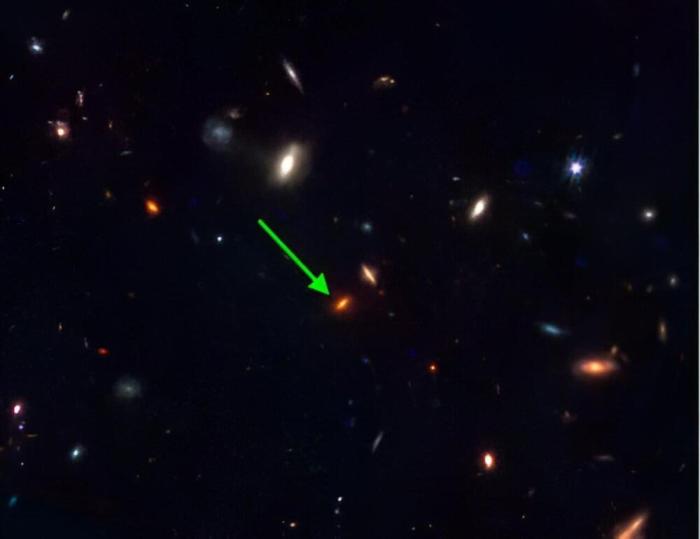
The visualization of scientific data is crucial for understanding complex concepts and sharing discoveries with a broader audience. Artists’ renderings, data visualizations, and contextual images help bring the abstract world of astrophysics to life. This section details how the superheated galaxy discovered by ALMA and JWST can be represented visually.
Artist’s Rendering of the Superheated Galaxy
An artist’s rendering would depict the superheated galaxy as a vibrant, dynamic structure. It’s crucial to portray the galaxy’s characteristics based on the data gathered by ALMA and JWST.The artist’s rendering should incorporate the following elements:
- Shape: The galaxy would likely appear as a somewhat irregular, possibly clumpy, structure. This reflects the early stages of galaxy formation, where galaxies are less settled and more chaotic compared to modern spiral or elliptical galaxies. The presence of multiple star-forming regions could give it a fragmented appearance.
- Color: The color palette would be dominated by blues and violets, indicative of the intense star formation activity. These colors represent the light emitted by hot, young, massive stars. Areas with dust, which absorb and re-emit light at longer wavelengths, might exhibit hints of red and orange.
- Surrounding Environment: The surrounding environment should be filled with diffuse gas and other smaller, fainter galaxies. This reflects the early universe’s density, where galaxies are closer together. Faint, wispy structures might represent the outflows of gas driven by stellar winds and supernovae. The background would consist of a tapestry of distant galaxies, subtly rendered to indicate the vastness of the universe.
Illustration of ALMA and JWST Data
Visualizing the combined data from ALMA and JWST is essential for illustrating the complementary strengths of these telescopes. An illustration would combine different datasets, providing a comprehensive view of the galaxy.The illustration should include:
- Color-Coding: The illustration would use a color-coding scheme to differentiate between data from ALMA (radio wavelengths) and JWST (infrared wavelengths). For instance, ALMA data, showing the distribution of dust and gas, could be represented in shades of green and yellow. JWST data, highlighting the distribution of stars and the presence of ionized gas, could be rendered in blues and reds.
- Labels and Annotations: Key features of the galaxy, such as star-forming regions, areas of intense dust emission, and the overall distribution of gas and stars, would be clearly labeled. The illustration might also include annotations explaining the significance of each dataset and how the two telescopes work together. For example, it could highlight how ALMA detects cold dust, while JWST observes the hot, young stars that heat that dust.
- Overlay of Data: The illustration could show an overlay of the ALMA and JWST data. This would clearly demonstrate the relationship between the different components of the galaxy. For example, the illustration could show how regions of intense star formation (from JWST data) are often associated with high concentrations of dust and gas (from ALMA data).
Image Depicting the Galaxy’s Location in the Early Universe
An image contextualizing the superheated galaxy within the early universe is important for understanding its significance. It shows the galaxy’s place in cosmic history.The image should:
- Show the Cosmic Microwave Background (CMB): The CMB, the afterglow of the Big Bang, would be represented as a diffuse, subtly textured background. This sets the cosmic time scale and provides a visual reference for the early universe.
- Include Other Galaxies: The image would show other early galaxies, albeit fainter and more distant. The distribution of these galaxies would highlight the large-scale structure of the early universe. These other galaxies may be smaller and less evolved than the superheated galaxy.
- Indicate Redshift: The redshift of the superheated galaxy and other galaxies should be indicated. Redshift is a measure of how much the light from a galaxy has been stretched due to the expansion of the universe. A higher redshift indicates that a galaxy is farther away and thus observed at an earlier time in cosmic history.
- Provide a Scale: A scale bar should be included to indicate distances. This helps the viewer understand the vastness of the universe and the distances between objects. The scale should be expressed in light-years or megaparsecs.
Ending Remarks
In conclusion, the discovery of this superheated galaxy, made possible by ALMA and JWST, is a landmark achievement in astrophysics. It challenges existing models of galaxy evolution and opens new avenues for understanding the early universe. This remarkable find fuels our curiosity, sparking new questions and paving the way for future exploration. The superheated galaxy, with its extreme conditions, stands as a testament to the dynamic and complex nature of the cosmos, urging us to continue pushing the boundaries of our knowledge.
Question & Answer Hub
What is the redshift of the superheated galaxy, and what does it mean?
The redshift of the superheated galaxy is extremely high, indicating it’s located very far away, and therefore, very old. Redshift is a measure of how much the light from a galaxy has been stretched due to the expansion of the universe. A higher redshift means the galaxy is farther away and we are seeing it as it appeared billions of years ago.
How do ALMA and JWST work together to study this galaxy?
ALMA and JWST complement each other. ALMA observes at millimeter and submillimeter wavelengths, detecting cold gas and dust, while JWST observes in the infrared, seeing through dust to study stars and other warm components. By combining their data, astronomers get a complete picture of the galaxy’s properties, from its composition to its star formation activity.
What are active galactic nuclei (AGN), and how could they influence the galaxy?
AGN are supermassive black holes at the centers of galaxies, actively feeding on surrounding matter. As material falls into the black hole, it emits tremendous amounts of energy, including X-rays and ultraviolet radiation, which can heat up the surrounding gas and dust, potentially contributing to the galaxy’s superheated state.
How does this discovery change our understanding of galaxy formation?
This discovery challenges the standard models of galaxy evolution, which often assume a more gradual heating process. The superheated galaxy suggests that extreme events, such as intense star formation or AGN activity, may have played a more significant role in the early universe. This implies that galaxy formation was more chaotic and energetic than previously thought.
What future observations are planned for this galaxy?
Scientists will continue to observe this galaxy with both ALMA and JWST, as well as other telescopes. Future observations will aim to gather more detailed data on the galaxy’s composition, star formation rates, and the activity of its central black hole. This will help refine our understanding of the processes that led to its superheated state and its evolution over time.